Edward Niedland–Charles Niedland sibling relationship
The Mystery of The Invisible DogThe sibling relationship between Edward Niedland and Charles Niedland comes into focus through Charles’s stewardship of his brother’s artistic legacy. After Edward’s death, Charles removes Edward’s collection to a safer place, returns works borrowed for a gallery show, and brings the Carpathian Hound to Fenton Prentice. His practical account of these tasks also gives the investigators their clearest picture of Edward’s work and belongings. The relationship is presented through what Charles knows and does, rather than through extended scenes of private grief or a detailed account of their earlier life together.
Edward’s life as an artist
Charles describes Edward as an artist whose work depended on specialized facilities: Edward had a workshop in East Los Angeles where he executed his sculptures, and, as Jupiter observes, molten glass required a furnace. The home where the brothers’ connection becomes visible was not that workshop. It was a modest house that served partly as a residence and partly as a studio, with a skylight cut into the living-room ceiling, drawing tables, an easel, photographs and sketches on the walls, and books piled around the room. The contrast between this working environment and the separate workshop establishes the practical division between Edward’s artistic process and the place where some of his work was kept.
Charles also characterizes Edward’s way of life through the things he left behind. The house contained a tiny television and a sophisticated stereophonic system, but Charles says the television’s nine-inch screen made it worth little and that Edward’s social security number was etched on the underside of the turntable and on the speakers, making the equipment difficult to sell. He sums up his brother as someone who lived simply, while Fenton Prentice calls Edward a great artist who lived for his art. Those remarks frame Edward through two complementary views: the modest scale of his possessions and the seriousness of his artistic commitment.
Charles as custodian of the work
After Edward died, Charles removed the small collection Edward had kept at the house. It included both Edward’s own pieces and works by other artists, and Charles says he moved them to a safer place. This is the clearest evidence of his role in protecting and managing his brother’s collection. It also distinguishes the sculptures’ custody from their authorship: the Hound was at the house by chance, among objects Charles was handling, rather than being part of an ordinary display of Edward’s work there.
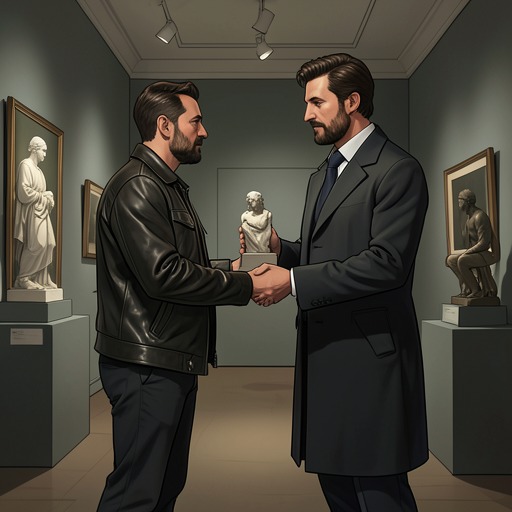
That responsibility continued after Edward’s gallery show ended. Charles had borrowed pieces from other patrons for the exhibition and was returning them. He came to the house intending both to deliver the Carpathian Hound to Fenton and to spend time sorting Edward’s books. The books and sculptures thus appear together in the unfinished business Charles undertakes after his brother’s death: one part of his task concerns Edward’s own artistic legacy, while another concerns works that must be returned to their owners. The account establishes Charles as the person carrying out those arrangements, without suggesting that he created the work or that the collection remained permanently in his possession.
The burglary and the brothers’ shared circle
The burglary interrupts Charles’s plan to deliver the Hound. He says that he left it at the house, went out to eat, and, on returning, saw an intruder through the window and called the police from a neighbour’s phone. The sculpture was the only object the burglar took, making the crime especially alarming to Fenton, who knew Edward’s work could attract people willing to consort with thieves. Charles, by contrast, initially treats the theft as an ordinary burglary and suggests the police may have frightened the intruder away before anything else was taken. Their differing reactions are recorded in the same conversation; the text does not establish that the brothers themselves disagreed about the Hound, but it shows Charles explaining the circumstances in which it was left vulnerable.
Charles’s relationship with Edward is also situated in a network of people connected to the artist. He was bringing the Hound to Fenton, who valued Edward’s talent, and had previously arranged his visit after speaking with Fenton by telephone. Charles’s explanation that he arrived when Fenton was expecting the investigators clarifies how the attempted delivery and the burglary became part of the same sequence. His account makes him an intermediary between Edward’s surviving work, its patrons, and those trying to understand why the Hound was singled out.
What the relationship establishes
The novel gives Charles a concrete posthumous role in Edward’s life: he knows where Edward worked, what he kept at the house, how the gallery show was assembled, and which objects still needed attention after it ended. His decision to move the collection to a safer place and his efforts to return borrowed pieces make the sibling bond legible through care expressed as practical responsibility. The evidence does not detail their childhood, the cause or circumstances of Edward’s death, or the full extent of their emotional closeness. Instead, it anchors their relationship in the work Edward left behind and in Charles’s efforts to account for it, protect it, and complete the arrangements surrounding it.